
In This Guide:
Introduction
Creating a Free vs Paid Courses is one of the most effective ways to share your expertise, help others learn, and build a sustainable online education business. Whether you’re a coach, consultant, trainer, educator, or subject matter expert, a well-designed course can expand your reach, strengthen your credibility, and create new revenue opportunities.
However, before you begin planning lessons or recording videos, you’ll face an important question:
Should you create a free or paid course first?
At first glance, the answer may seem straightforward. A free course can help attract learners and build trust, while a paid course allows you to generate revenue from your expertise. But the decision isn’t simply about choosing a price. It’s about understanding your current business goals, knowing your audience, and selecting a strategy that supports long-term growth.
Many first-time course creators assume that offering a free course is always the safest option. Others believe charging from the beginning positions them as a premium expert. While both approaches can be successful, neither is universally right. The best choice depends on where you are in your course creation journey and what you want your first course to achieve.
This guide is written specifically for course creators, not learners. Instead of helping you decide which course to take, it provides a practical framework for deciding which type of course to create first. By the end of this article, you’ll understand when a free course makes sense, when a paid course is the better option, and how both can work together to build a successful online education business.
The Problem
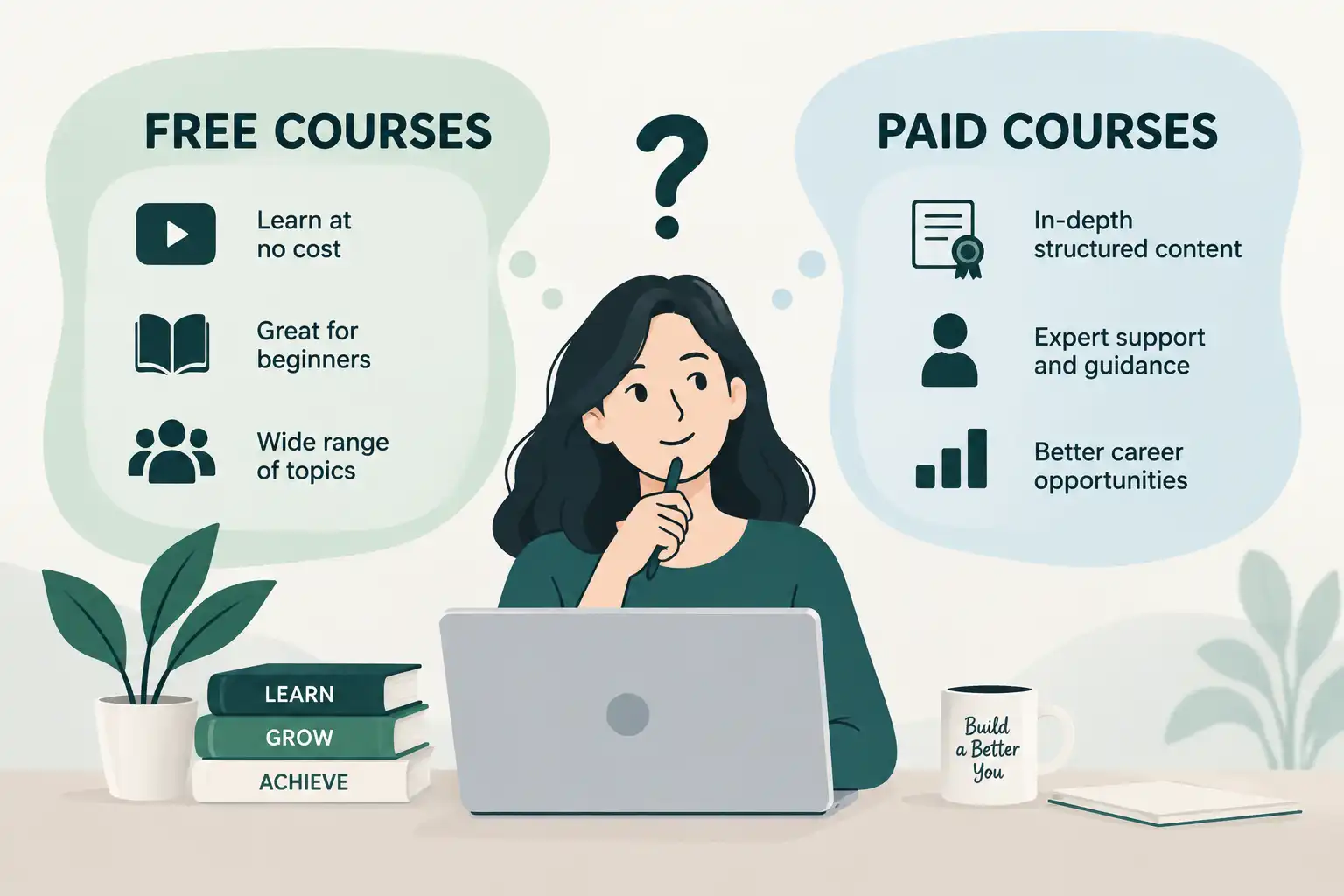
Choosing between ‘Free vs Paid Courses’ is one of the first strategic decisions every course creator faces. While it may seem like a simple pricing decision, it often determines how you attract learners, validate your expertise, and grow your online education business.
Many first-time course creators hesitate because they aren’t sure if learners are ready to pay for their knowledge. Others believe they should offer everything for free to build an audience before thinking about revenue. On the other hand, some assume that charging from the beginning automatically positions them as a premium expert. These assumptions can lead to uncertainty and delay, making it difficult to move forward with course creation.
The challenge becomes even greater when there is no clear understanding of the purpose behind the first course. Is the goal to build trust? Validate a course idea? Grow an email list? Generate revenue? Without answering these questions, creators often choose a strategy based on guesswork rather than business objectives.
As a result, many invest significant time developing a course before confirming whether there is genuine learner demand. This can lead to low enrolments, poor engagement, and missed opportunities for growth.
The good news is that there isn’t a universally correct choice. The most effective strategy depends on your goals, your audience, and the stage of your business. Understanding these factors is the first step toward creating a course that delivers value for learners while supporting long-term business success.
Why This Matters
The decision to create a Free vs Paid Courses affects much more than how much learners pay to access your content. It influences how people discover your expertise, how they perceive your brand, and how your online education business develops over time.
A free course is often used to introduce learners to your teaching style, demonstrate your expertise, and reduce the barrier to entry. It can help you validate a course idea, grow your email list, and build trust before introducing more comprehensive learning experiences.
A paid course serves a different purpose. It is designed to provide a structured learning experience that helps learners achieve a specific outcome while generating revenue for your business. Because learners make a financial investment, they often have higher expectations and a stronger commitment to completing the course.
This decision also influences several important aspects of your course creation strategy, including:
- The depth and scope of your curriculum.
- Your pricing and monetization approach.
- Marketing and learner acquisition strategies.
- Learner expectations and engagement.
- Future course offerings and product pathways.
- The long-term growth of your online education business.
Rather than asking, “Which option is better?”, a more useful question is:
“Which option best supports my learners and my business goals right now?”
Answering this question early helps you make informed decisions throughout the course creation process, creating a stronger foundation for both learner success and sustainable business growth.
Free vs Paid Courses: A Step-by-Step Decision Framework
There isn’t a one-size-fits-all answer to whether you should create a free or paid course first. The right decision depends on your goals, your audience, and the stage of your online education business. Instead of making a decision based on assumptions, use the following framework to evaluate your situation and choose the strategy that best supports both your learners and your business.
Step 1: Define the Purpose of Your First Course
Before deciding on pricing, identify the primary purpose of your first course.
Ask yourself:
What do I want this course to achieve?
Your answer will influence every decision that follows—from the type of content you create to how you market it.
Your primary objective may be to:
- Build your reputation as an expert.
- Grow your email list.
- Validate a course idea.
- Generate your first online course sales.
- Introduce learners to your teaching style.
- Expand your existing coaching or consulting services.
If your goal is to build trust and attract new learners, a free course is often the better starting point. If your goal is to generate revenue from an existing audience, a paid course may provide greater value for both you and your learners.
Clearly defining your objective ensures that your course supports your broader business strategy rather than becoming an isolated project.
Step 2: Understand Your Audience
A successful course isn’t built around what you want to teach—it’s built around what your audience needs to learn.
Before choosing between a free and paid course, consider questions such as:
- Do people already know your work?
- Have you built trust through blogs, webinars, podcasts, social media, or consulting?
- Do you already have clients who would benefit from structured learning?
- Are people actively asking for training on this topic?
If you’re just beginning to build your audience, a free introductory course can help establish credibility, attract new learners, and encourage engagement without asking for an immediate financial commitment.
However, if you already have an engaged audience that trusts your expertise, a paid course can provide a structured learning experience that delivers measurable outcomes.
Remember, learners rarely pay for information alone. They invest in guidance, structure, accountability, and results.
Step 3: Validate Your Course Idea Before You Build
One of the most common mistakes first-time course creators make is spending weeks or even months developing a complete course before confirming that people actually want it.
Course validation reduces this risk.
Instead of relying on assumptions, gather feedback from your target audience before investing significant time and resources.
Simple ways to validate your course idea include:
- Conducting audience surveys.
- Running polls on social media.
- Hosting a free webinar.
- Delivering a short workshop.
- Creating a pilot or mini course.
- Building a waitlist to measure interest.
These activities help you understand learner needs, identify knowledge gaps, and refine your course content before full development begins.
Validation doesn’t just improve your course—it gives you confidence that you’re solving a real problem for a real audience.
Step 4: Compare Free and Paid Courses
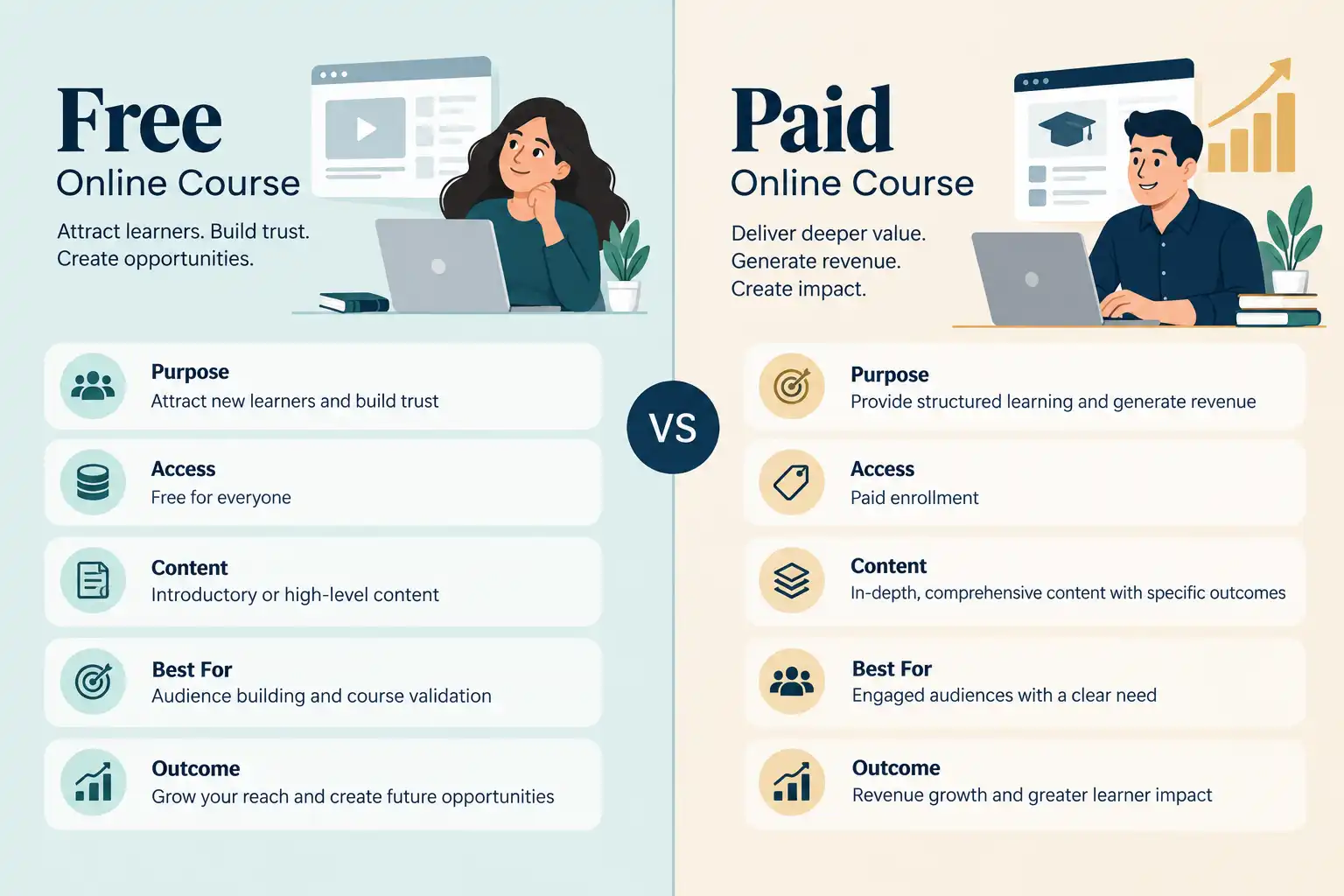
Choosing between Free vs Paid Courses becomes much easier when you understand the purpose each approach serves. Neither option is inherently better; each supports different business objectives.
| Feature | Free Course | Paid Course |
| Primary Goal | Build trust and attract learners | Generate revenue and deliver transformation |
| Best For | Audience growth, course validation, brand awareness | Monetization, premium learning, business growth |
| Learner Commitment | Lower | Higher |
| Revenue | Indirect | Direct |
| Marketing Role | Lead generation | Core product offering |
| Learner Expectation | Quick wins and introductory learning | Comprehensive, outcome-focused learning |
A free course works well when your priority is building credibility, validating your expertise, or introducing learners to your teaching style.
A paid course is more appropriate when you have established expertise, a clearly defined learner problem, and an audience that already trusts your knowledge.
Rather than deciding based on price, choose the option that best supports your current business objectives.
Step 5: Think Beyond One Course
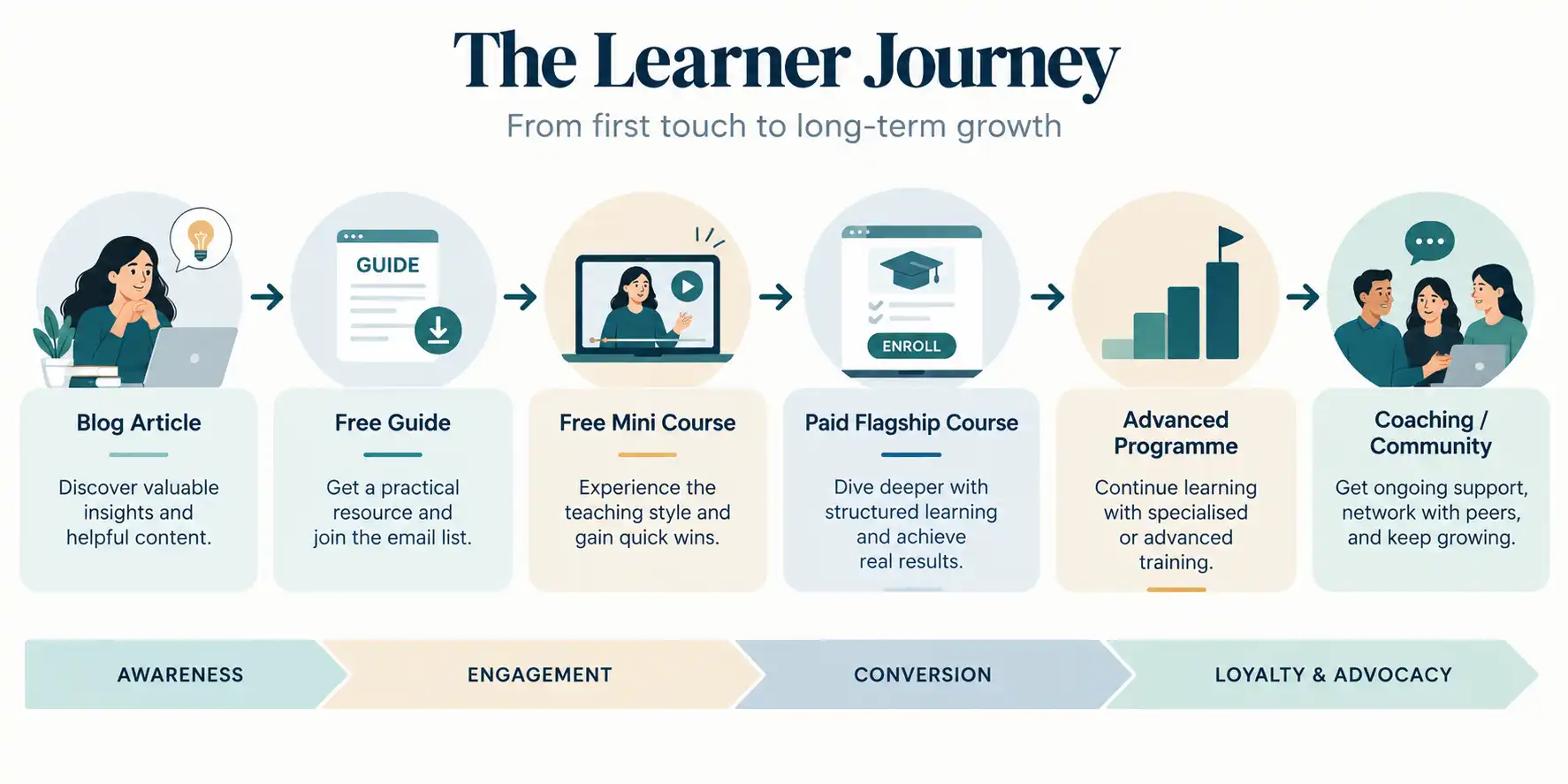
Many successful online education businesses don’t rely on a single course. Instead, they create a learner journey that gradually moves learners from free resources to premium learning experiences.
A typical learner journey may look like this:
Blog Article
⬇
Free Guide or Webinar
⬇
Free Mini Course
⬇
Paid Flagship Course
⬇
Advanced Programme or Coaching
Each stage builds trust, demonstrates expertise, and prepares learners for the next step in their learning journey.
When viewed from this perspective, free and paid courses are not competing strategies. They complement one another as part of a sustainable online education business.
Instead of asking whether you should choose one or the other, consider how both can work together to support long-term growth.
Step 6: Choose the Strategy That Fits Your Situation
Once you’ve clarified your goals, understood your audience, and validated your course idea, choosing the right strategy becomes much easier.
Start with a Free Course if you:
- Are building your personal brand.
- Have little or no existing audience.
- Want to validate your course idea.
- Need learner feedback and testimonials.
- Want to grow your email list before selling.
A free course helps lower the barrier to entry, allowing learners to experience your teaching style before committing to a premium programme.
Start with a Paid Course if you:
- Already have an engaged audience.
- Have proven expertise or industry experience.
- Regularly receive requests for training.
- Solve a high-value business problem.
- Have already validated learner demand.
A paid course is the better option when learners already recognize your expertise and are willing to invest in achieving a specific outcome.
Quick Decision Matrix
If you’re still unsure where to begin, use this simple decision matrix as a guide.
| If your goal is to… | Recommended Approach |
| Build an audience | Free Course |
| Validate a course idea | Free Course |
| Grow an email list | Free Course |
| Generate revenue | Paid Course |
| Position yourself as an expert | Paid Course |
| Build a long-term online education business | Combine Free and Paid Courses |
Remember, your first course doesn’t define your entire business. Many successful course creators begin with one strategy and evolve their offerings as their audience, expertise, and business grow.
Practical Examples
Understanding the theory behind Free vs Paid Courses is important, but seeing how different strategies work in real situations makes it easier to decide which approach fits your goals.
Example 1: A New Career Coach
A career coach is launching an online business but has a small audience and limited brand recognition. Instead of immediately selling a premium programme, they create a 30-minute free course on interview preparation. The course provides practical tips, builds credibility, and encourages learners to subscribe to their email list for additional resources.
Why it works: The free course helps validate learner interest while building trust and creating a pipeline for future paid coaching programmes.
Example 2: An Experienced Consultant
An operations consultant has spent years helping organizations improve business processes and regularly receives requests for training. With an established reputation and a network of existing clients, they launch a paid online course that teaches a proven framework for improving operational efficiency.
Why it works: Existing credibility and validated demand allow the consultant to monetize their expertise immediately while delivering a structured learning experience with measurable outcomes.
Example 3: A Corporate Training Company
A training company wants to expand its online education business. It offers free webinars and downloadable learning resources to attract potential learners before introducing paid certification programmes and customized corporate training solutions.
Why it works: Each resource supports the next stage of the learner journey, creating long-term engagement while helping the company grow a sustainable education business.
Common Mistakes to Avoid
Choosing between a Free vs Paid Courses becomes easier when you avoid a few common mistakes.
Choosing price before understanding your audience.
Don’t decide whether your course should be free or paid before understanding who you want to reach and what they need.
Building before validating.
Developing a complete course without testing learner demand can lead to wasted time and resources. Use surveys, workshops, webinars, or pilot sessions to gather feedback first.
Assuming free always means better for beginners.
A free course can be useful for audience building and validation, but a paid course may be appropriate when you already have an engaged audience and validated demand.
Treating free and paid courses as competing options.
They can serve different purposes within the same education business. A free resource can introduce learners to your expertise, while a paid course can provide deeper, structured learning.
Focusing only on revenue.
The first course should have a clear purpose. Consider learner needs, business goals, audience maturity, and validation before deciding on your approach.
Best Practices
Whether you choose a free or paid course, following a structured approach increases your chances of success.
- Start with a clear objective. Decide whether your priority is audience growth, course validation, or revenue generation before planning your content.
- Validate before you build. Use surveys, webinars, pilot sessions, or learner interviews to confirm demand before investing significant time in course development.
- Focus on one transformation. Rather than trying to teach everything you know, solve one specific learner problem exceptionally well.
- Design for measurable outcomes. Structure your course with clear learning objectives, practical activities, assessments, and resources that help learners apply what they learn.
- Measure and improve continuously. Monitor learner feedback, completion rates, engagement, and assessment performance to refine your course over time and improve the overall learning experience.
Following these practices helps you create courses that not only attract learners but also deliver meaningful results and support long-term business growth.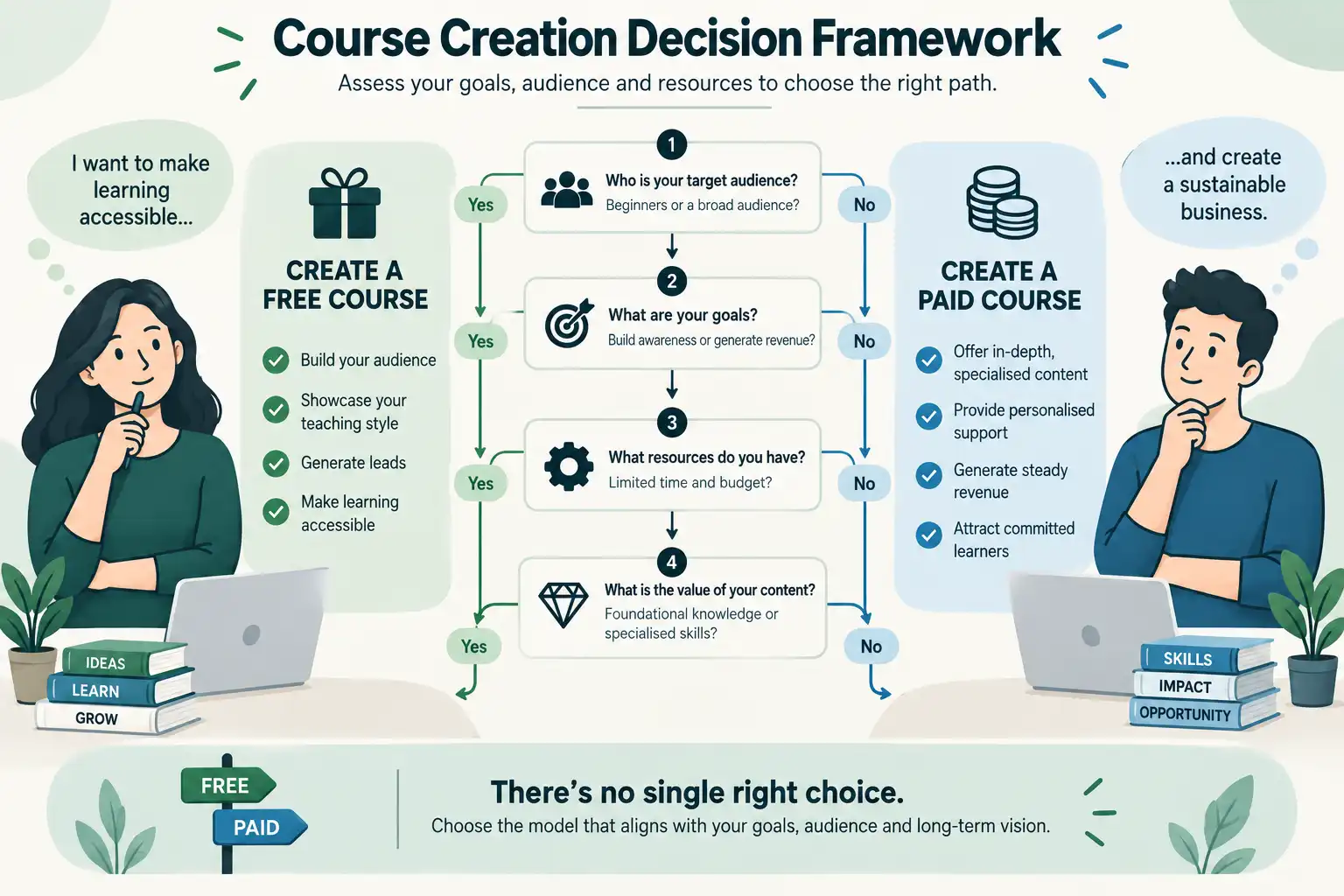
Related Articles:
- Why Most Online Courses Fail Before They Launch
- Kajabi, LearnDash, or Nothing? Why Tools Don’t Build Online Schools — Systems Do
- Content Marketing Tips to Promote Your E-Learning Course
If you’re unsure whether to create a Free vs Paid Courses or how to plan your course before investing in development—Wizcabin can help you take a structured approach to course planning and validation.
Ready to build your course planning system?
Book a 90-minute Strategy Call with Wizcabin. We will help you bypass the tool trap and map out a high-converting system for your courses.