
In This Guide:
Introduction
Creating an online course takes time, expertise, and careful planning. However, when it comes to how to price your online course, one important question remains:
How much should you charge for it?
Setting the right price is one of the biggest challenges for course creators. Charge too little, and you may undervalue your expertise while limiting your business growth. On the other hand, charge too much without demonstrating enough value, and potential learners may hesitate to enroll.
The truth is, there isn’t a single “perfect” price that works for every online course. The right price depends on several factors, including your target audience, the problem your course solves, the learning experience you provide, your market positioning, and your long-term business goals. Pricing should reflect the value your learners receive—not just the number of lessons or hours of content. This approach is commonly known as value-based pricing, where pricing is based on the value a product or service provides to customers.
 In this guide, you’ll learn the key factors that influence online course pricing, explore common pricing models, and follow a practical framework to help you choose a price with confidence. Whether you’re launching your first online course or reviewing your existing pricing strategy, this guide will help you make informed decisions that benefit both your learners and your business.
The Problem
However, many course creators struggle with pricing because they don’t know where to start.
Some worry that a higher price will reduce sales, while others believe lowering the price will attract more learners. As a result, pricing decisions are often based on guesswork, competitor prices, or the amount of time spent creating the course rather than the value it delivers.
Common questions include:
How much should I charge for my online course?
Should I price my course based on its length or the results it delivers?
Is a one-time payment better than a subscription?
How do I know if my target audience will pay my chosen price?
Should I offer discounts or launch with a lower introductory price?
Without a clear pricing strategy, it’s easy to underprice your expertise, overprice your offer, or create confusion that affects enrolments and long-term business growth.
Why This Matters
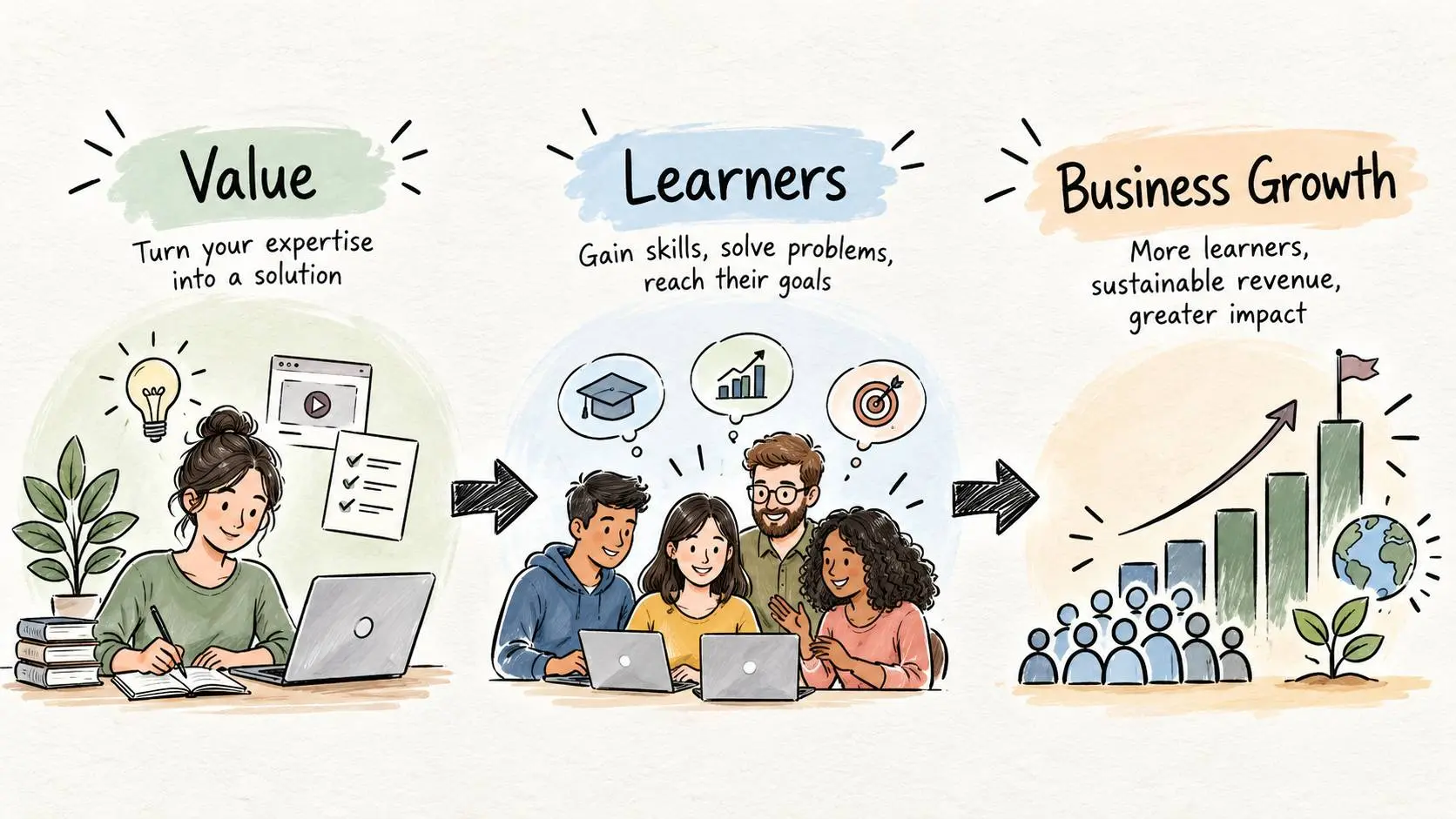
Pricing is more than just assigning a number to your course—it’s a strategic business decision that influences how learners perceive your offer and how your online education business grows.
 For example,
A well-priced course helps you:
Attract the right learners who value your expertise.
Communicate the quality and outcomes your course provides.
Generate sustainable revenue to support marketing, learner support, and future course development.
Build confidence in your brand and establish a stronger market position.
In addition, effective pricing gives you the flexibility to invest in improving your courses, updating content, and creating better learning experiences over time.
Rather than asking, “What’s the cheapest price I can offer?”, a better question is:
“What price accurately reflects the value and transformation my course provides?”
Answering that question is the foundation of a successful pricing strategy—and that’s exactly what you’ll learn in the next section.
The Wizcabin 7-Step Online Course Pricing Framework
Pricing your online course isn’t about picking a random number or copying what others charge. A well-planned pricing strategy considers your learners, the value your course delivers, and your long-term business goals.
Therefore, use this seven-step framework to determine a price that reflects the true value of your course while supporting sustainable business growth.
Step 1: Start with the Transformation, Not the Content
One of the biggest mistakes course creators make is pricing their course based on the number of videos, modules, or hours of content.
Learners don’t buy courses because they’re long—they buy them because they want a specific result.
Ask yourself:
What problem does my course solve?
What new skill will learners gain?
How will their work or life improve after completing the course?
Is the outcome measurable or career-focused?
For example, a two-hour course that helps learners pass a professional certification exam may justify a higher price than a ten-hour course that only provides general information.
As a result, Price the transformation your course delivers, not the amount of content it contains.
Step 2: Understand Your Target Audience
Your ideal learners play a major role in determining an appropriate price.
Different audiences have different expectations, budgets, and reasons for investing in online learning.
Consider questions such as:
Are your learners students, working professionals, business owners, or organisations?
Are they looking to build a hobby, advance their career, or solve a business problem?
How much are they willing to invest to achieve that outcome?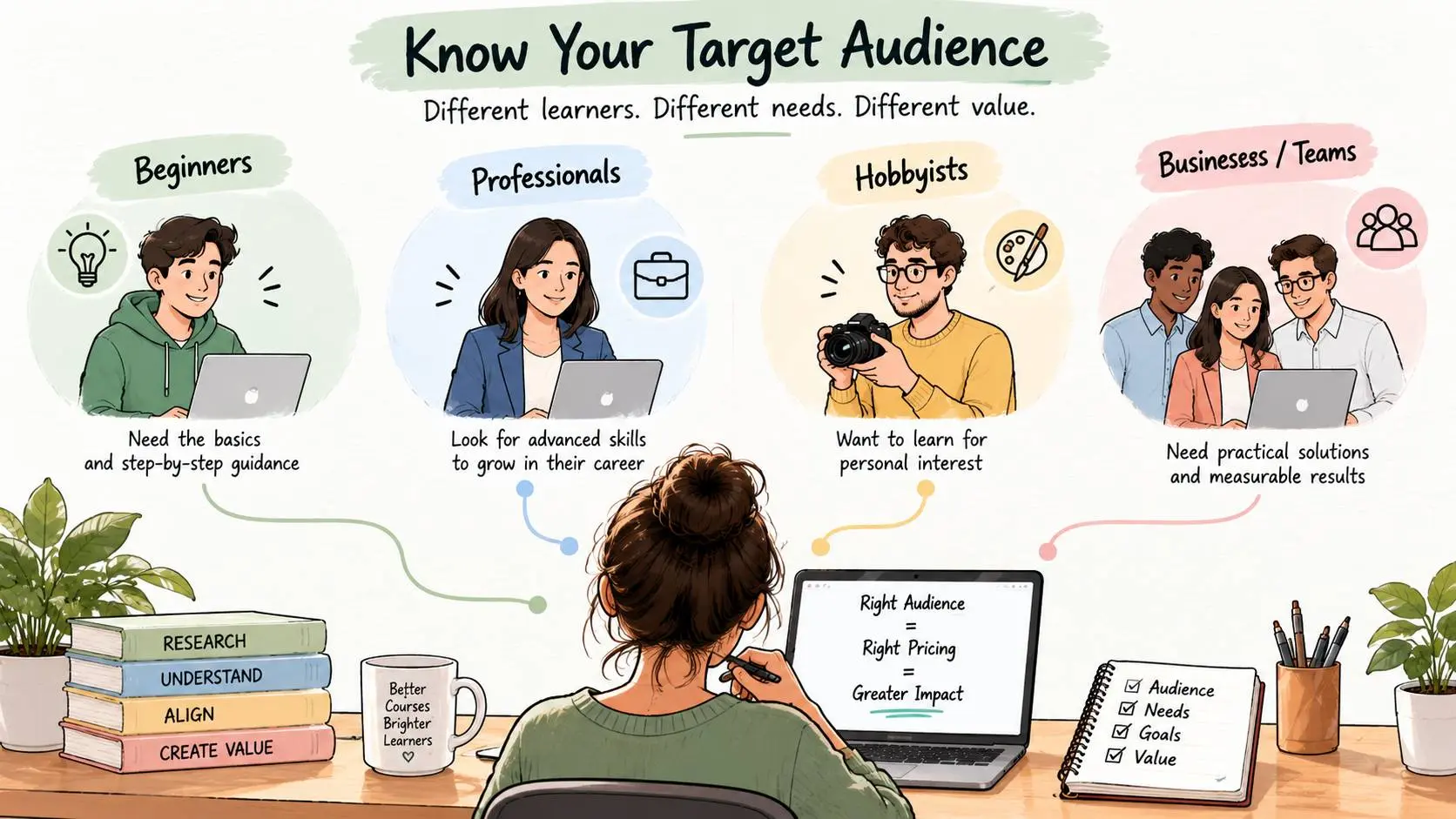
For example:
A hobby course may need an affordable entry price.
A professional certification course can often command a higher price because it supports career advancement.
Corporate training programmes may require customised pricing based on organisational needs.
Overall, understanding your audience helps ensure your pricing aligns with both their expectations and the value they expect to receive.
Step 3: Evaluate the Complete Learning Experience
In addition, pricing should reflect the overall learning experience—not just the course content.
Think about everything learners receive when they enrol.
Your course may include:
Structured learning modules
Practical assignments
Downloadable resources
Assessments and quizzes
Certificates of completion
Community access
Live Q&A sessions
Personal feedback or mentoring
Course updates
Each additional element increases the value of the learning experience and can justify a higher price.
Rather than asking, “How many lessons does my course have?”, ask:
“What complete learning experience am I providing?”
Step 4: Research the Market Without Copying It
However, looking at competitor pricing is useful, but it should provide context—not dictate your pricing.
Research similar courses to understand:
Typical price ranges
Features included
Course format
Learner support
Certification options
Instructor positioning
Then identify how your course is different.
Perhaps you offer:
More practical projects
Better learner support
Industry-recognised certification
Smaller learning groups
Personal coaching
Updated content
If your course provides greater value, your pricing doesn’t have to match your competitors.
Your goal is to understand the market while clearly communicating why your course is worth its price.
Step 5: Choose the Right Pricing Model
There isn’t a single pricing model that works for every online course.
The right approach depends on your course format, audience, and business goals.
Common pricing models include:
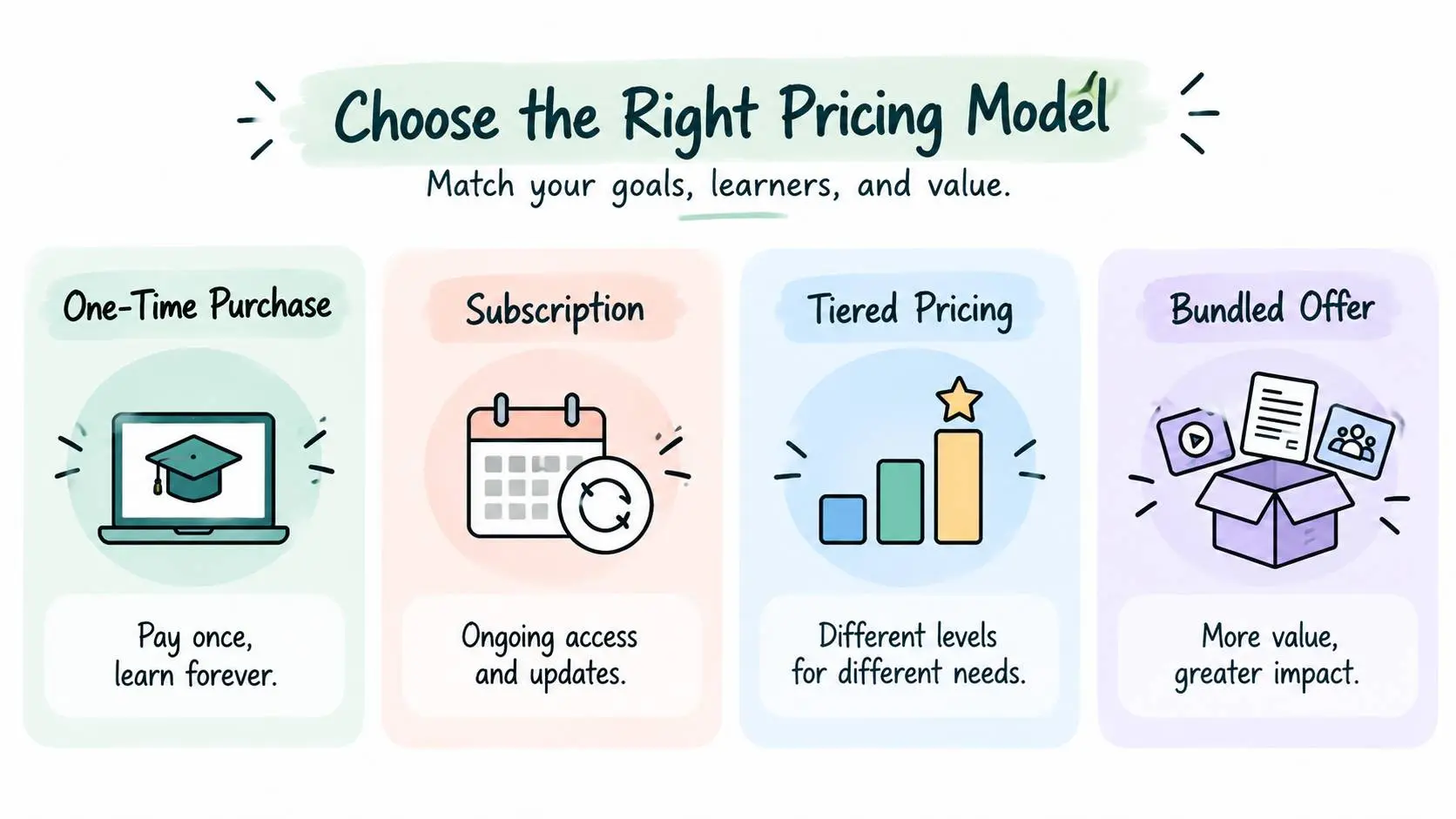
One-Time Payment
Learners pay once for long-term or lifetime access. This model works well for self-paced courses.
Subscription
Learners pay monthly or annually to access a growing library of courses or ongoing learning resources.
Tiered Pricing
Offer multiple packages—such as Basic, Standard, and Premium—each with different levels of support or additional resources.
Bundle Pricing
Combine related courses into a package at a discounted price, encouraging larger purchases while providing greater value.
Therefore, choose the pricing model that best supports both your learners and your business objectives.
Step 6: Validate Your Price Before You Launch
Even the most carefully planned pricing strategy should be tested before a full launch.
Instead of relying on assumptions, gather feedback from your target audience.
You can validate your pricing by:
Running surveys
Interviewing potential learners
Launching a beta programme
Offering an early-bird price
Testing pre-orders
Collecting feedback from pilot participants
Validation helps you understand whether lAearners perceive your pricing as fair and whether any adjustments are needed before your official launch.
Additionally, testing early can improve both learner confidence and enrolment rates.
Step 7: Review and Optimise Your Pricing Over Time
Pricing isn’t something you decide once and never revisit.
As your course grows, your pricing should evolve alongside it.
Consider reviewing your pricing when:
You add new modules or resources.
You introduce certificates or coaching.
Learner demand increases.
You receive consistently positive reviews.
Your brand becomes more established.
Market conditions change.
Avoid making frequent or unnecessary price changes, as this can confuse potential learners and reduce trust.
Instead, review your pricing periodically to ensure it continues to reflect the value your course provides.
Bringing It All Together
Effective course pricing is the result of thoughtful planning—not guesswork.
When you focus on learner outcomes, understand your audience, design a valuable learning experience, research the market, choose the right pricing model, validate your decisions, and review your strategy over time, you can confidently set a price that supports both learner success and long-term business growth.
The next section explores practical examples of how these principles can be applied to different types of online courses.
Practical Online Course Pricing Examples
Understanding pricing principles is easier when you see how they apply in real-world scenarios. Here are a few examples of how different types of online courses can be priced based on their value, audience, and learning experience.
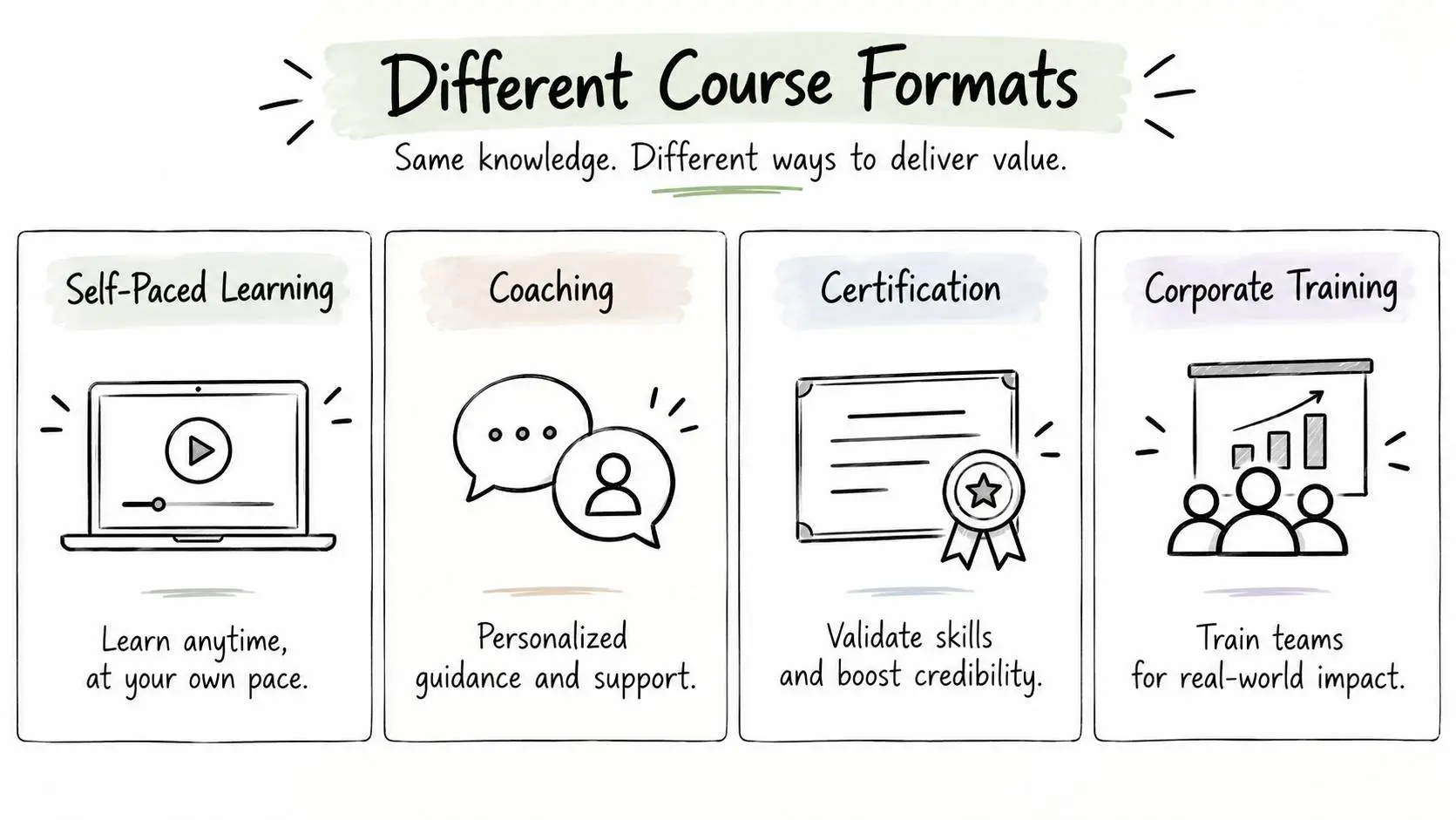
Example 1: Self-Paced Skill Development Course
A graphic designer creates a self-paced course teaching beginners how to use Canva for social media design. The course includes video lessons, downloadable templates, quizzes, and lifetime access.
Pricing Considerations:
Beginner audience
Self-paced learning
Limited instructor interaction
Practical downloadable resources
Suitable Pricing Approach: One-time payment with an affordable to mid-range price.
Example 2: Professional Certification Course
A cybersecurity professional develops a certification preparation course with structured modules, practice assessments, mock exams, and a completion certificate.
Pricing Considerations:
Career-focused outcome
High learner value
Certification support
Comprehensive learning resources
Suitable Pricing Approach: Premium one-time payment, reflecting the measurable career benefits and comprehensive learning experience.
Example 3: Business Coaching Programme
A business coach offers a programme combining self-paced lessons, weekly live coaching sessions, community access, and personalised feedback.
Pricing Considerations:
High level of instructor involvement
Personalised support
Ongoing interaction
Business transformation
Suitable Pricing Approach: Tiered pricing or a premium package, with higher-priced options including additional coaching and mentoring.
Example 4: Corporate Training Programme
A company develops an online onboarding course for client organisations, including customised content, progress reporting, assessments, and administrator dashboards.
Pricing Considerations:
Business-to-business audience
Customisation
Multiple learners
Organisation-wide deployment
Suitable Pricing Approach: Custom pricing based on organisation size, learner numbers, and implementation requirements.
These examples demonstrate that successful pricing depends on the value delivered, the target audience, and the overall learning experience—not simply the amount of content included.
Best Practices for Online Course Pricing
When pricing your online course, keep these best practices in mind:
Focus on learner outcomes rather than course length or the number of lessons.
Research your target audience to understand their expectations, goals, and budget.
Study competitor offerings to understand the market, but don’t copy their pricing.
Choose a pricing model that aligns with your course format and business objectives.
Validate your pricing through surveys, beta launches, or early feedback before a full launch.
Review your pricing periodically as your course, reputation, and learner demand evolve.
Communicate your value clearly so learners understand what they’re gaining by enrolling.
Overall, Following these practices will help you build a pricing strategy that supports both learner success and sustainable business growth.
Common Mistakes in Online Course Pricing
Avoid these common pricing mistakes that many new course creators make:
Pricing Based Only on Course Length
A longer course isn’t automatically more valuable. Learners care about the results they achieve, not the number of hours they spend watching videos.
Copying Competitor Prices
Every course is different. Matching another creator’s pricing without considering your own audience, value proposition, and business goals can lead to poor pricing decisions.
Ignoring Your Target Audience
Pricing should reflect the needs and purchasing power of your intended learners. A price suitable for corporate professionals may not be appropriate for students or hobby learners.
Forgetting Ongoing Costs
Course creation is only one part of the investment. Therefore, remember to account for platform fees, marketing, software subscriptions, learner support, and future content updates when planning your pricing.
Changing Prices Too Frequently
Frequent price changes can confuse potential learners and reduce trust. Instead, review your pricing at regular intervals based on learner feedback, course improvements, and market trends.
Summary
Pricing your online course is about more than choosing a number—it’s about communicating the value of the learning experience you provide. The right price should reflect your learners’ transformation, your target audience, your course format, and your business goals.
Ultimately, by understanding your audience, evaluating the value of your course, researching the market, selecting the right pricing model, validating your pricing before launch, and reviewing it as your business grows, you can develop a pricing strategy that supports both learner success and long-term business sustainability.
Remember, there isn’t a universal “correct” price. The best price is one that aligns with the value your course delivers and the outcomes your learners achieve.
Frequently Asked Questions
-
How much should I charge for my online course?
There is no fixed price for an online course. The right price depends on your target audience, the value your course provides, the learning experience, your market positioning, and your business goals.
-
What is the best pricing strategy for an online course?
Value-based pricing is often the most effective strategy. Instead of pricing based on course length, focus on the results and transformation your learners will achieve.
-
Should I compare competitor prices?
Yes, competitor research helps you understand market expectations. However, use it as a benchmark rather than copying another creator’s pricing. Your course should be priced according to its unique value.
-
Is it better to charge a one-time fee or a subscription?
It depends on your course model. Self-paced courses often work well with one-time payments, while memberships and regularly updated course libraries are better suited to subscription pricing.
-
Can I increase my course price later?
Yes. Many course creators begin with introductory or beta pricing and increase prices as they add content, receive positive reviews, and build their reputation.
-
Should I offer discounts?
Occasional launch or seasonal promotions can encourage enrolments. However, frequent discounts may reduce the perceived value of your course.
-
How do I know if my course is priced correctly?
Validate your pricing through learner feedback, surveys, beta launches, or pre-orders. Monitor enrolments and learner feedback to determine whether adjustments are needed.
-
What factors influence online course pricing?
Important factors include your target audience, course outcomes, instructor expertise, learning experience, course format, competitor landscape, and business objectives.
-
Does adding coaching or certification justify a higher price?
Yes. Additional services such as live coaching, personalised feedback, recognised certifications, or community access increase the overall value of the learning experience and can support premium pricing.
-
How often should I review my course pricing?
Review your pricing periodically, especially after updating your course, introducing new features, receiving strong learner feedback, or responding to changing market conditions.
If you’re unsure how to price your online course or how to plan your course before investing in development—Wizcabin can help you take a structured approach to course planning, validation, and pricing.
Ready to build your course development system?
Book a 90-minute Strategy Call with Wizcabin. We will help you bypass the tool trap and map out a high-converting system for your courses.