
In This Guide:
-
-
- 1. Introduction
- 2. The Problem: The Scope Creep Trap
- 3. Why Format Selection Matters
- 4. Step-by-Step Decision Framework: Mini Course vs. Full Course
- 5. Practical Examples: Corporate Training vs. Consultant Funnels
- 6. Best Practices for Course Scoping
- 7. Common Mistakes to Avoid
- 8. Summary
- 9. Frequently Asked Questions
-
Introduction
Most experts make the mistake of choosing an LMS platform before designing their curriculum. But your course structure, instructional design, and student engagement model should always dictate your technology—never the other way around. At Wizcabin, we partner with educators from initial learning objectives in Storyline and Rise to full LMS deployment, ensuring your online academy delivers measurable learning outcomes from day one.
When subject matter experts and L&D leaders decide to build an online training program, they almost always hit the same crossroads: should we launch a tightly focused mini-course or build a comprehensive, full-scale curriculum?
Choosing between these two formats dictates your budget, production timeline, and how your audience perceives your expertise.
The Problem: The Scope Creep Trap
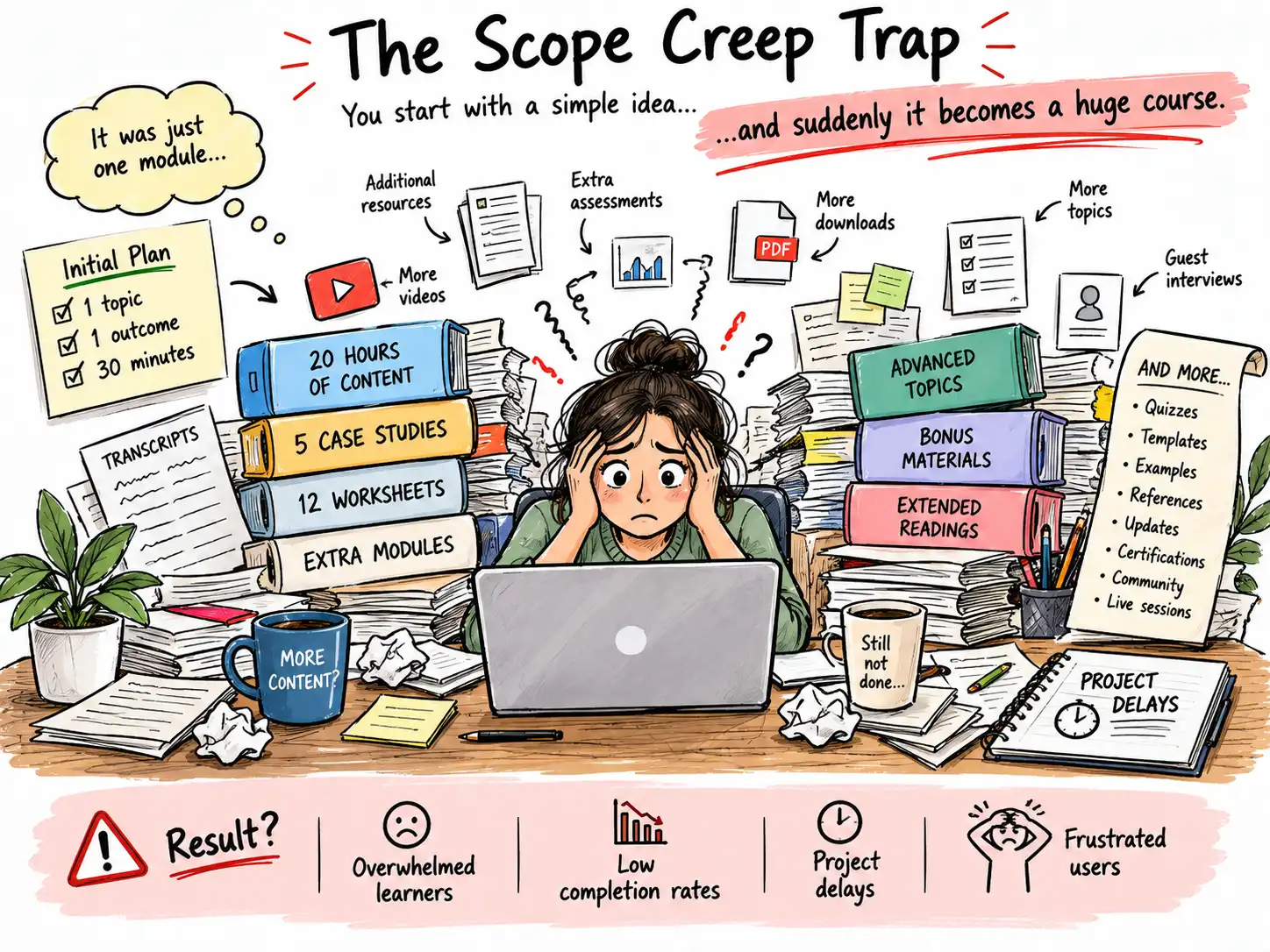
Most creators fall into the trap of packing too much information into their initial offering. You want to provide maximum value, so you stuff 20 hours of content, five case studies, and twelve downloadable worksheets into a single introductory module.
The result? Overwhelmed learners, abysmal completion rates, and endless project delays.
When you build a 40-hour full course when your audience only needs a quick tactical win, you will deal with low engagement and frustrated users. Conversely, try to squeeze an entire professional certification into a 20-minute mini-course, and your learners will feel shortchanged.
Matching your content scope to the right format ensures high engagement and measurable results. When you structure your curriculum correctly from the start, you avoid costly re-engineering down the road.
Why Format Selection Matters
The choice between a mini-course and a full course comes down to scope, depth, and learning outcomes.
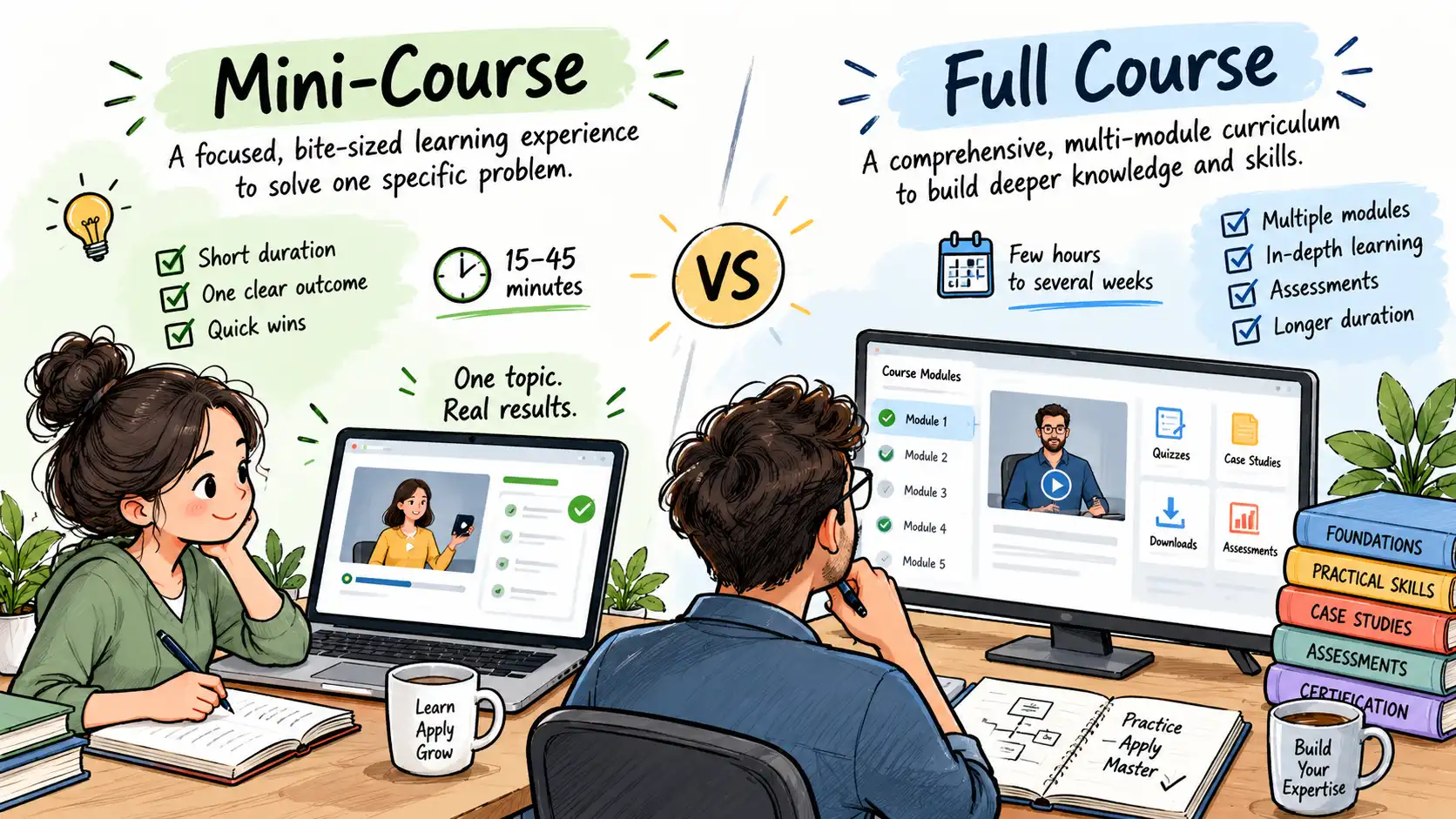
- Mini-Course: A bite-sized, single-outcome learning experience. It typically takes 15 to 45 minutes to complete and solves one specific problem for the learner.
- Full Course: A comprehensive, multi-module curriculum. It addresses broader competency gaps, incorporates multiple assessments, and can take anywhere from a few hours to several weeks to finish.
Understanding this dynamic is the first step in effective instructional design. You can explore how structured learning experiences come together by reviewing our Wizcabin Solutions & E-Learning Architecture.
Your course format directly impacts completion rates, customer acquisition costs, and production overhead. If you are weighing the business implications of free lead-generation modules versus paid comprehensive academies, read our guide on Free vs Paid Courses: Strategic Guide.

Step-by-Step Decision Framework: Mini Course vs. Full Course
To determine whether your next educational project should be a rapid microlearning module or an expansive signature program, walk through this practical evaluation framework.
Step 1: Define the Core Learning Objective
Ask yourself what exact behavioral change must happen by the end of the training.
- If the objective is singular—such as setting up a specific software integration or learning basic workplace safety protocols—a mini-course is your best option.
- If the objective requires mastering a complex domain—such as executive leadership or full-stack software development—you need a full-scale curriculum.
Step 2: Evaluate Your Audience’s Time Commitment
Look closely at your learners’ daily environments. Busy corporate professionals and distracted consumers rarely have four hours to sit through dense video modules.
- When building for fast-paced corporate settings, leverage microlearning principles. Learn more about this approach in Is It Important to Add Microlearning?
Step 3: Map Out Your Storyboard
Before opening an authoring tool, map your modules on paper. Skipping this step leads to bloated, unfocused content.
- Protect your project from scope creep by always starting your process by examining Why Should You Start with an E-Learning Storyboard.
Step 4: Plan Your Technical Infrastructure
How your learners access and interact with your content depends heavily on your technical architecture.
- Whether you are deploying SCORM-compliant packages or streaming video lessons, your learning management system must track progress accurately. Read our practical advice in How to Use Your LMS Flawlessly.
- For technical standards on how digital courses communicate with your platform, review How SCORM Works: Complete Technical Guide.
Practical Examples: Corporate Training vs. Consultant Funnels
To see how this applies in the real world, let us look at two distinct use cases.
Scenario A: Corporate Compliance Training
- The Challenge: An enterprise needs to train 5,000 employees on data privacy regulations annually.
- The Wrong Approach: Building a 3-hour video course that employees rush through while multitasking.
- The Right Approach: A 15-minute interactive mini-course built in Articulate Rise, featuring scenario-based questions and instant feedback. It solves one specific compliance requirement without crushing productivity.
Scenario B: The Consultant’s Signature Program
- The Challenge: An independent consultant wants to sell a high-ticket business coaching program.
- The Wrong Approach: Trying to sell a $5,000 package cold to a cold-traffic audience with no prior trust.
- The Right Approach: Launching a focused 30-minute mini-course as a high-intent diagnostic lead magnet. Once students achieve a quick win, they are seamlessly upsold into the comprehensive signature academy.
Best Practices for Course Scoping
Creating an effective online course is not about how much information you can fit into it. It is about selecting the right information, structuring it effectively, and helping learners achieve a measurable outcome. A well-scoped course gives learners a clear path from where they are now to where they need to be—without unnecessary content getting in the way.
1. Focus on Outcomes, Not Content Volume
A common misconception in e-learning is that more content automatically means more value. In reality, learners are more interested in what they will be able to do after completing the course.
Instead of asking, “How many hours of content should we create?”, start by asking:
“What should the learner be able to do differently after completing this course?”
For example, a 30-minute course that enables an employee to correctly identify and report a cybersecurity threat may be more valuable than a three-hour course filled with theoretical information.
Define your learning outcomes first, then build only the content required to achieve them. This approach keeps the course focused, reduces cognitive overload, and makes your learning experience more purposeful.
2. Keep Your Authoring Tools and Content Flexible
Your course should be designed for change. Industry standards, company policies, software interfaces, and compliance requirements can evolve quickly. A course that is difficult to update can become outdated before it has even reached its full potential.
Using flexible, cloud-based authoring tools can make it easier to revise lessons, replace outdated information, update assessments, and maintain consistency across modules.
The goal is not simply to build a course once—it is to create a learning asset that can evolve with your learners and your industry.
3. Use Completion Data to Refine Your Scope
Your course analytics can tell you more than whether learners finished the training. They can reveal where learners lose interest, struggle with a concept, or abandon a module altogether.
For example, if most learners complete Modules 1 and 2 but consistently drop off during Module 3, that is a signal worth investigating. The problem could be excessive content, unnecessary complexity, poor pacing, or a lack of interaction.
Use completion rates, assessment results, learner feedback, and engagement data to continuously refine your course.
Good instructional design doesn’t end when the course is published—it improves through iteration.
4. Design for the Learner’s Real Environment
Before deciding on course length, consider where, when, and how your learners will actually use the training.
A sales professional completing training between client meetings has very different needs from a university student studying a subject in depth. Similarly, employees completing mandatory compliance training may prefer short, scenario-based modules rather than lengthy lectures.
Understanding the learner’s environment helps you choose the appropriate duration, format, level of interaction, and assessment strategy.
Common Mistakes to Avoid
The “Everything Bagel” Trap
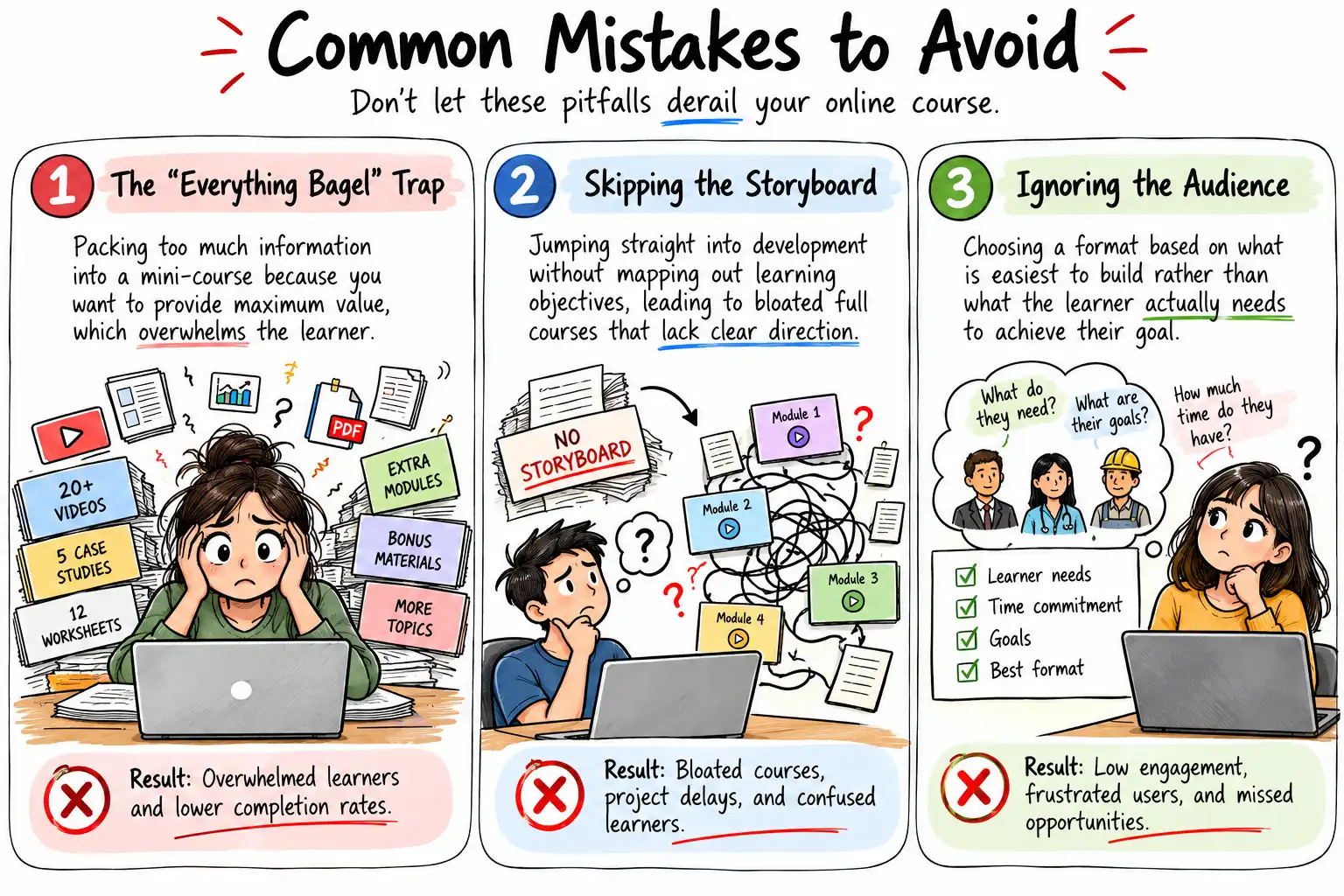
One of the most common mistakes in course development is trying to include everything in a single learning experience. Subject matter experts often want to provide maximum value, so they keep adding examples, videos, case studies, activities, and downloadable resources. While the intention is good, too much information can quickly overwhelm learners—especially in a mini-course designed to deliver a quick, focused outcome. Instead of asking how much content you can include, ask whether each piece of content directly contributes to the learner’s objective. If it does not, consider removing it, moving it to a supplementary resource, or saving it for a more advanced course.
Skipping the Storyboard
Jumping straight into course development without creating a storyboard can create problems later in the project. Without a clear plan, learning objectives may become disconnected from the content, modules can become unnecessarily long, and assessments may fail to measure what learners are actually expected to achieve. A storyboard provides a structured blueprint for the entire learning experience, allowing you to organize content, interactions, activities, and assessments before development begins. Spending time on this stage can significantly reduce rework, prevent scope creep, and ensure that every part of the course has a clear purpose.
Ignoring the Audience
Another common mistake is choosing a course format based on what is easiest or fastest for the development team rather than what the learner actually needs. A format that works well for one audience may be completely unsuitable for another. For example, busy corporate employees may benefit from short, scenario-based microlearning, while professionals developing an advanced skill may require a longer curriculum with practice, assessments, and multiple learning activities. Before deciding between a mini-course and a full course, consider your learners’ existing knowledge, available time, learning environment, and desired outcome. When the format is designed around the learner rather than the convenience of development, the learning experience becomes more relevant, engaging, and effective.
Summary
The decision between a mini-course and a full course is more than a question of length, budget, or production time. It is an instructional design decision that can directly influence learner engagement, completion rates, knowledge retention, and the overall effectiveness of your training program.
A well-designed mini-course delivers a focused learning experience with a clear, achievable outcome. A full course, on the other hand, provides the depth, practice, assessment, and progression required to develop broader skills or competencies.
The key is knowing when to use each format.
Before beginning development, consider your learning objectives, audience, content complexity, learner time commitment, assessment requirements, and long-term business goals. Map the experience through a storyboard, remove unnecessary content, and use learner data to refine the course after launch.
Ultimately, successful e-learning is not about creating the longest course or producing the most content.
It is about creating the right learning experience for the right learner, at the right level of depth.
Whether you are developing a 20-minute microlearning module or a multi-week learning academy, strong instructional design begins with one simple principle:
Design with purpose. Build with clarity. And always keep the learner at the center.
Frequently Asked Questions
1. Should I build a mini course or full course?
Choose a mini-course if you are teaching a single, tactical skill that takes under 45 minutes to master. Choose a full course if you are addressing a broad competency gap that requires multiple modules, deep assessments, and weeks of guided study.
2. What is the difference between a mini course and a flagship program?
A mini-course focuses on one specific outcome with minimal friction, often acting as a lead magnet or quick corporate training module. A flagship program is a comprehensive curriculum designed to transform a learner’s professional capability from the ground up.
3. How long should a mini course take to complete?
A well-designed mini-course typically takes between 15 and 45 minutes to finish. It should be concise enough to complete in a single sitting without causing cognitive overload.
4. How do I structure an online learning program without scope creep?
Start with strict learning objectives and map your curriculum using a detailed storyboard before touching any authoring software. Read our guide on Why You Should Start with an E-Learning Storyboard for a step-by-step framework.
5. Should I bundle multiple mini-courses into a full course later?
Yes. Modular course design allows you to build individual microlearning assets first, test their effectiveness, and then bundle them into a comprehensive flagship academy down the road.
6. How do I handle SCORM tracking differently for bite-sized modules versus deep curricula?
Bite-sized modules often rely on simple completion triggers, while deep curricula require granular tracking across multiple SCORM-compliant quizzes and modules. Review the technical foundations in How SCORM Works: Complete Technical Guide.
7. At what point does microlearning fail to solve a complex competency gap?
Microlearning fails when the topic requires deep critical thinking, complex synthesis, or multi-step behavioral shifts that cannot be practiced in isolation. For those scenarios, a full curriculum is mandatory.
8. Can a mini course generate sustainable revenue for consultants?
Yes. Many consultants use mini-courses as low-ticket tripwires or high-intent lead generators that filter qualified leads into high-ticket consulting and signature academies.
9. What are the ongoing maintenance costs of maintaining a large training curriculum?
Large curricula require regular reviews for outdated content, broken links, compliance updates, and multi-language translations. Factoring in this maintenance overhead is essential during initial budgeting.
10. How can I evaluate my current course structure before investing in development?
You can review real-world examples of effective course architecture by exploring our Example Courses & Interactive Demos.
Build the Right Course From the Start
Ready to design an online training program that drives real behavioral change? Let our instructional design team help you map your curriculum, develop engaging Storyline and Rise modules, and configure your LMS for flawless delivery.
Schedule your technical architecture review via the Contact Wizcabin Strategy Consultation page today.