
In This Guide:
-
-
- 1. Introduction
- 2. The Problem: Unstructured Content Causes Cognitive Overload
- 3. Why Proper Module Structure Matters
- 4. The Step-by-Step Solution: How to Structure Your Learning Modules
- 5. Real-World Scenarios in Action
- 6. Best Practices for Module Design
- 7. Common Mistakes to Avoid
- 8. Summary
- 9. FAQ
-
Introduction
Learning how to structure learning modules effectively is an important step in creating a successful online course. However, most experts make the mistake of choosing an LMS platform or authoring tool before designing their curriculum. But your course structure, instructional design, and student engagement model should always dictate your technology—never the other way around.
When you begin with technology, it is easy to let the capabilities of the platform determine how your course is organized. You may find yourself designing content around available templates, blocks, interactions, or platform limitations rather than around what your learners actually need to know and do. A stronger approach starts with the learning experience.
Before selecting an LMS, authoring tool, or delivery format, first determine what learners need to accomplish, how the content should be organized, and what type of practice will help them apply the knowledge.
At Wizcabin, we partner with educators, organizations, and subject matter experts throughout this process—from defining learning objectives and structuring courses in Storyline and Rise to developing complete digital learning experiences and deploying them through an LMS.
The result is not simply a collection of lessons placed inside a platform. It is a structured learning experience designed around measurable outcomes.
The Problem: Unstructured Content Causes Cognitive Overload
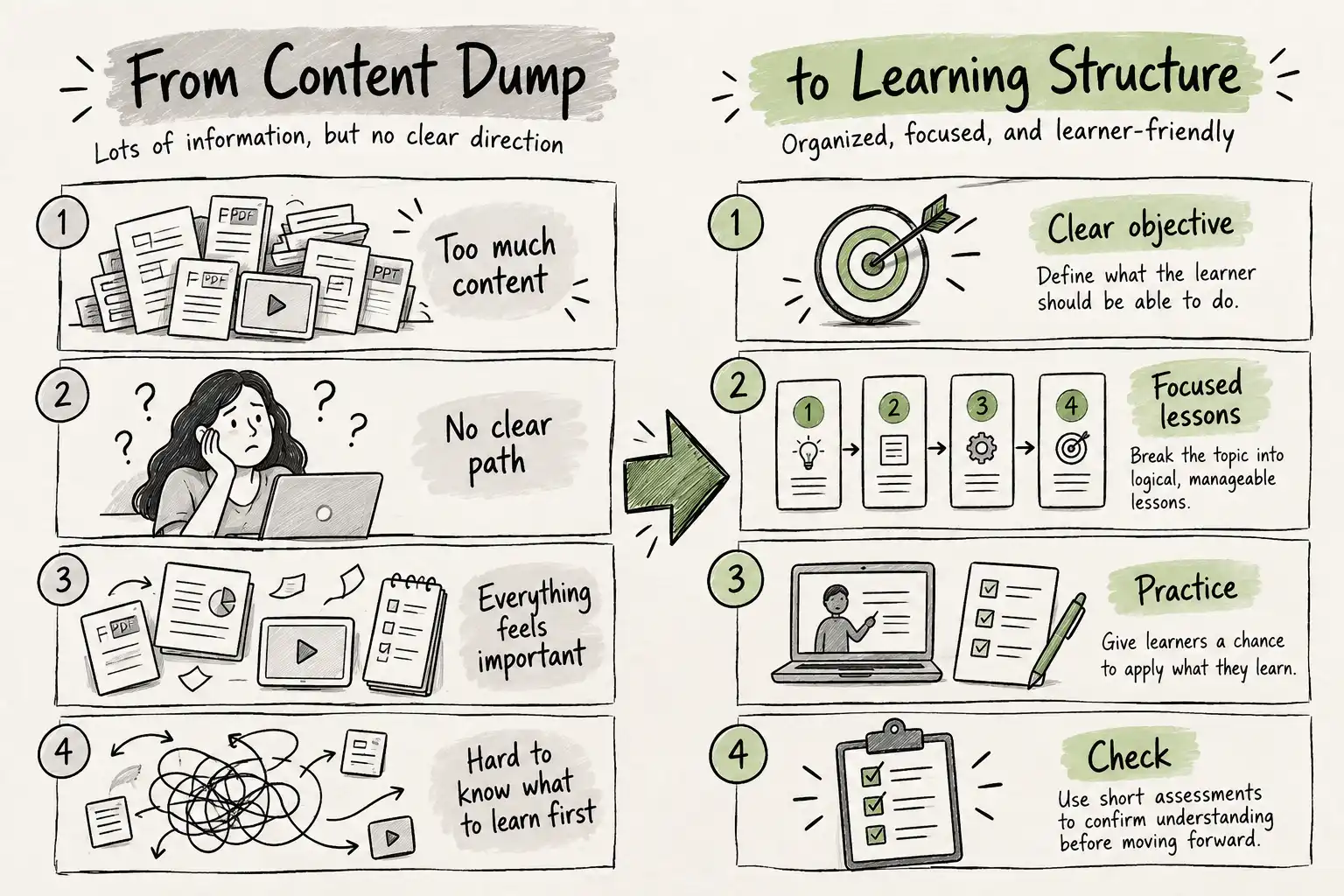
When corporate trainers, coaches, and subject matter experts set out to build a digital course, they often begin with what they already have.
They collect every slide deck, PDF, handbook, presentation, video recording, reference document, and supporting resource available to them. They then attempt to transform all of that material into an online course.
From the expert’s perspective, this approach can feel thorough. After all, more information may seem to mean more value.
For the learner, however, the experience can feel completely different.
For example, imagine opening a course and being presented with dozens of lessons, long blocks of text, hours of video, multiple downloadable documents, and assessment questions without a clear indication of where to begin.
The learner does not necessarily see a comprehensive learning experience.
They see a mountain of information.
Human working memory can only process a limited amount of information at a time. When learners are exposed to large volumes of unstructured content, they may struggle to identify what matters, what they should remember, and what they are expected to do with the information.
Instead of focusing on learning and application, they spend mental effort simply trying to navigate the material.
This can lead to:
- Reduced engagement
- Lower completion rates
- Poor knowledge retention
- Difficulty identifying key concepts
- Increased learner frustration
- Wasted training time and resources
The solution is not necessarily to remove valuable information.
The solution is to organize that information around the learner’s journey.
Why Proper Module Structure Matters
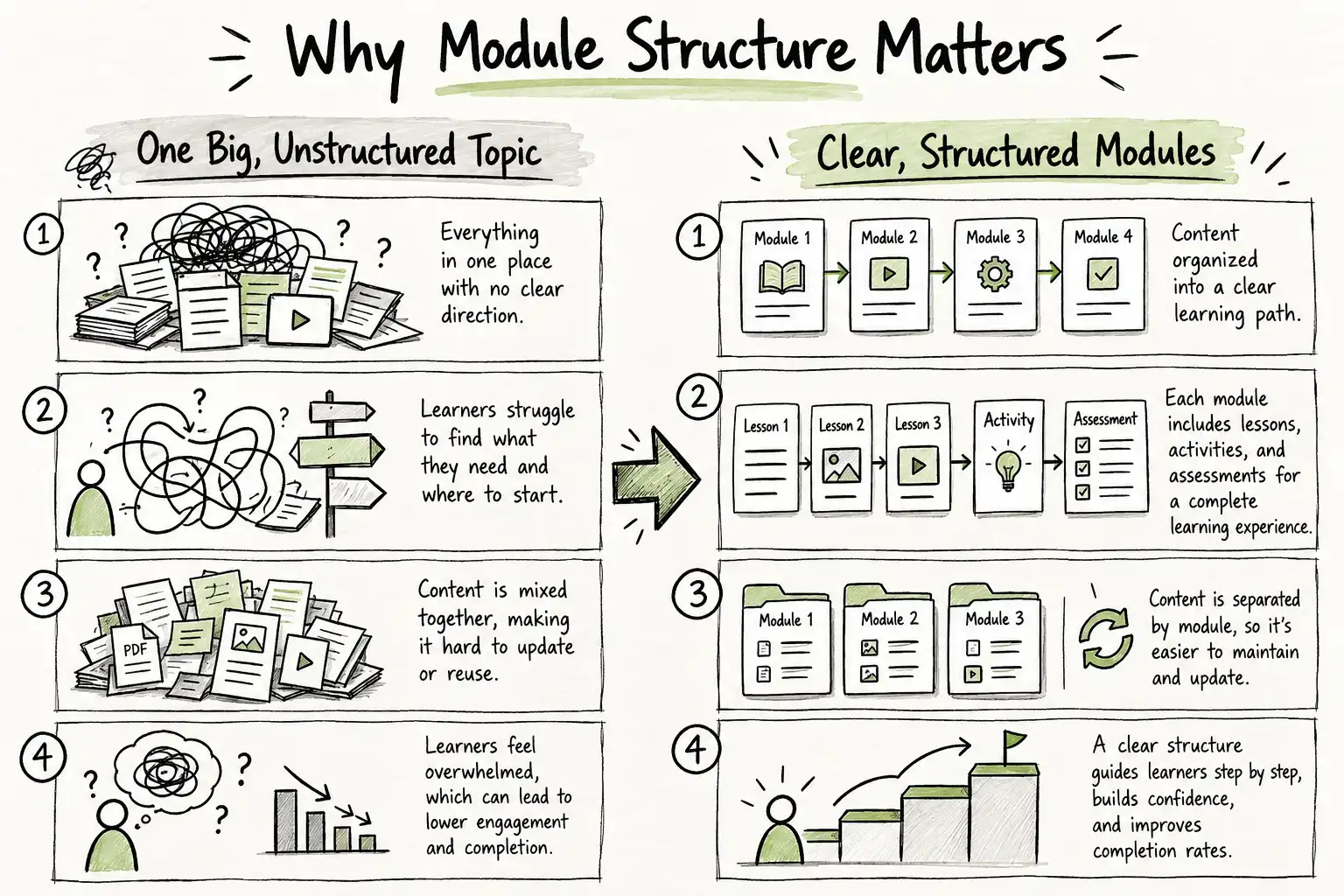
Module structuring is the practice of breaking a large or complex subject into smaller, logical units of learning.
Instead of presenting an entire subject as one continuous experience, you organize the content into chapters, modules, lessons, activities, and assessments that guide the learner progressively through the topic.
More importantly, a well-structured module also makes the course easier to maintain.
The learner should understand:
What am I learning?
Why does it matter?
What am I expected to do with this information?
How will I know whether I have understood it?
Each module should therefore connect to a specific learning objective and contribute to the larger goal of the course.
For example, rather than creating one large module called “Workplace Safety,” you might organize the subject into focused learning areas such as identifying hazards, understanding safety procedures, responding to incidents, and applying safety protocols in realistic situations.
This structure gives the learner a logical path through the subject.
Proper structure also makes the course easier to maintain and update. If a policy, procedure, or regulation changes, you can identify the relevant module rather than having to revise an enormous block of content.
Whether you are designing mandatory compliance training for a global enterprise or building commercial professional development programs through Wizcabin Solutions & E-Learning Architecture, organization is the backbone of a scalable learning experience.
The Step-by-Step Solution: How to Structure Your Learning Modules
Moving from a scattered collection of ideas to a polished curriculum requires a deliberate framework.
Before opening an authoring tool or beginning development, establish the structure of the learning experience.
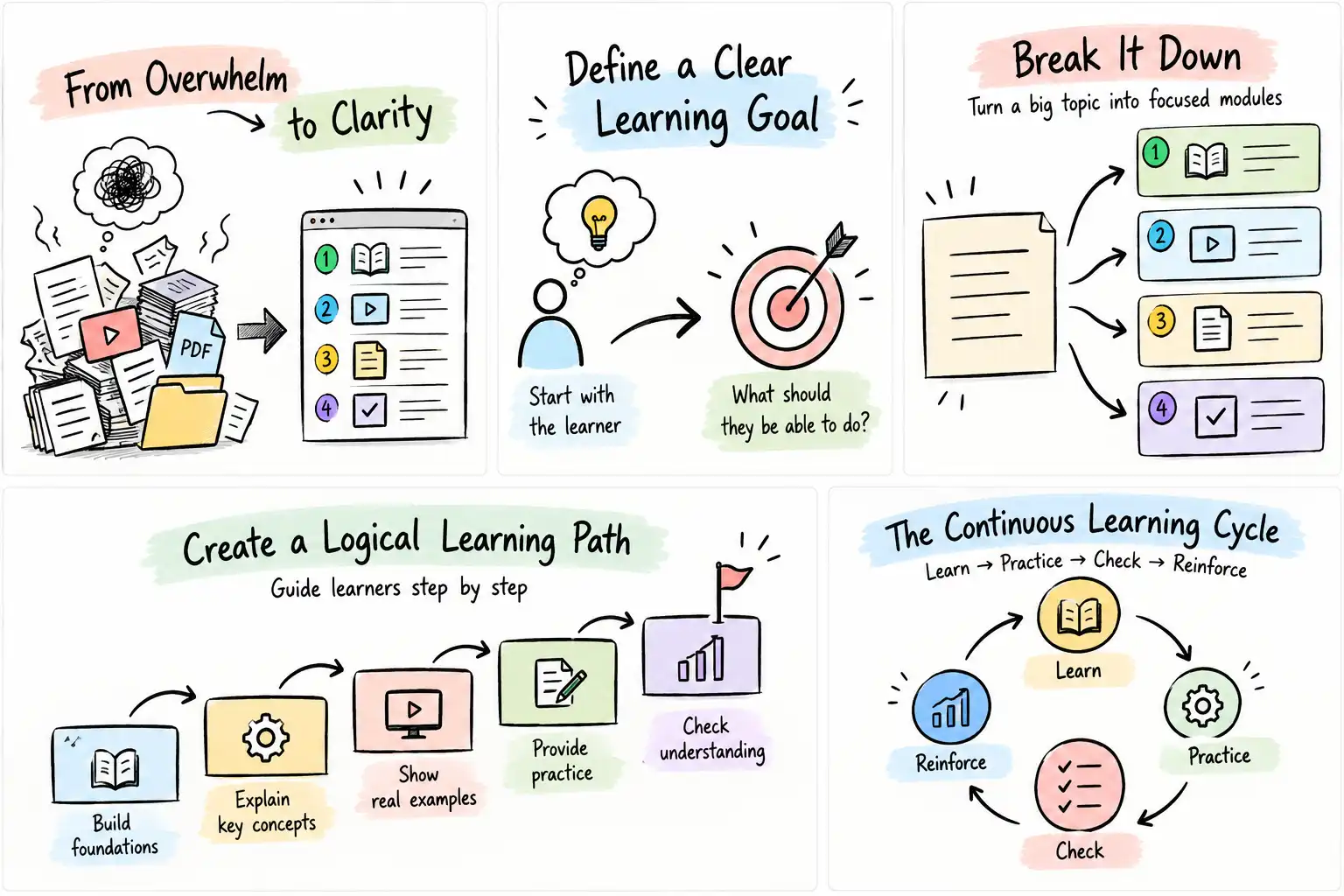
A practical approach is to work through four stages.
1. Define Clear Learning Objectives First
First, start by defining what learners should be able to do after completing the module. Before deciding what content to include, determine what the learner should be able to do after completing the module.
This is where many course creators go wrong.
They begin by asking: “What information do I have?”
Instead, begin with: “What should the learner be able to accomplish after this module?”
Avoid vague objectives such as:
“Understand workplace compliance.”
Instead, define an observable outcome such as:
“Identify three safety violations in a simulated workplace scenario.”
The second objective provides much clearer direction.
Once the objective is defined, you can determine what content is necessary, what examples should be included, what activity will provide practice, and what assessment can demonstrate mastery.
This also prevents unnecessary information from finding its way into the course simply because it happens to be available in the source material.
2. Chunk Content Into Micro-Units
Next, once your learning objectives are clear, break the content into smaller learning units.
A large topic can initially be divided into three to five logical modules, with each module containing shorter lessons focused on specific concepts or skills.
The purpose of chunking is not simply to make the course shorter.
It is to make the learning experience easier to navigate and process.
A learner should be able to complete a lesson, understand what they have learned, and recognize how that learning connects to the next part of the course.
For professional learners, shorter units can also make training easier to fit into busy schedules.
Instead of requiring someone to dedicate an uninterrupted hour to one topic, you can provide focused learning experiences that can be completed in smaller sessions.
For more guidance on shorter learning experiences, explore Is It Important to Add Microlearning. Pasted markdown
3. Establish Scaffolding and Sequence
After that, organize the learning units in a logical sequence. After chunking the content, determine the order in which learners should encounter it.
Not every concept should be introduced at the same level of complexity.
Start with foundational concepts before moving toward advanced application.
For example, a learner may first need to understand terminology and basic principles before they can analyze a realistic scenario or make a complex decision.
This is the role of instructional scaffolding.
The course provides learners with the knowledge and support they need at each stage before gradually increasing the level of complexity.
A useful progression might look like:
Foundation → Explanation → Demonstration → Practice → Application → Assessment
This sequence helps learners build confidence before they are expected to perform independently.
Your modules should therefore feel like connected steps rather than isolated containers of information.
4. Integrate Formative Assessments Early
Finally, include formative assessments throughout the module. Assessment should not appear only at the end of the course.
If learners spend several hours consuming content before discovering that they misunderstood an important concept, the opportunity for correction has already been delayed.
Instead, incorporate small formative assessments throughout the learning experience.
These can include:
- Quick knowledge checks
- Reflection questions
- Scenario-based decisions
- Matching activities
- Short quizzes
- Practice exercises
- Application questions
The purpose of these activities is not always to assign a score.
They provide learners with an opportunity to check their understanding and allow the course to reinforce important concepts before moving forward.
This creates a continuous learning loop:
Learn → Practice → Check → Reinforce → Continue
That is much more effective than treating assessment as something that happens only after all instruction has finished.
Real-World Scenarios in Action
To understand how modular design functions in practice, consider two common applications:
- The Corporate Compliance Overhaul:A company facing low completion rates redesigned its compliance training by restructuring long modules into focused learning units, each centered on a specific compliance objective. Instead of presenting policies as large blocks of information, the new structure introduced shorter sections, practical examples, and knowledge checks at key points.As a result, learners could move through the content in smaller, more manageable sections.
- The Consultant Client Onboarding Program: A specialized business consultant wanted to scale their 1-on-1 advisory framework into a digital academy. By breaking their proprietary methodology into six weekly milestone modules, they gave clients clear pacing, reduced support requests, and delivered immediate wins.
When you are ready to see how modular design comes to life in professional digital formats, browse our Example Courses & Interactive Demos.
Best Practices for Module Design
- Keep lengths consistent: Aim for uniform pacing across your modules so learners can easily predict and schedule their study time.
- Map on paper first: Never let software dictate your curriculum. Sketch your module hierarchy on a whiteboard or storyboard before touching Articulate Storyline or Rise. Learn more about planning frameworks in our guide on Why Should You Start with an E-Learning Storyboard.
- Balance media types: Alternate between concise text, interactive graphics, audio snippets, and practical exercises to keep attention high in distracting work environments.
- Keep technical standards in mind: If your modules need to report completion data back to an enterprise platform, ensure your packaging adheres to industry standards. Read our technical overview on How SCORM Works: Complete Technical Guide to understand how structured units communicate with your LMS.
Common Mistakes to Avoid
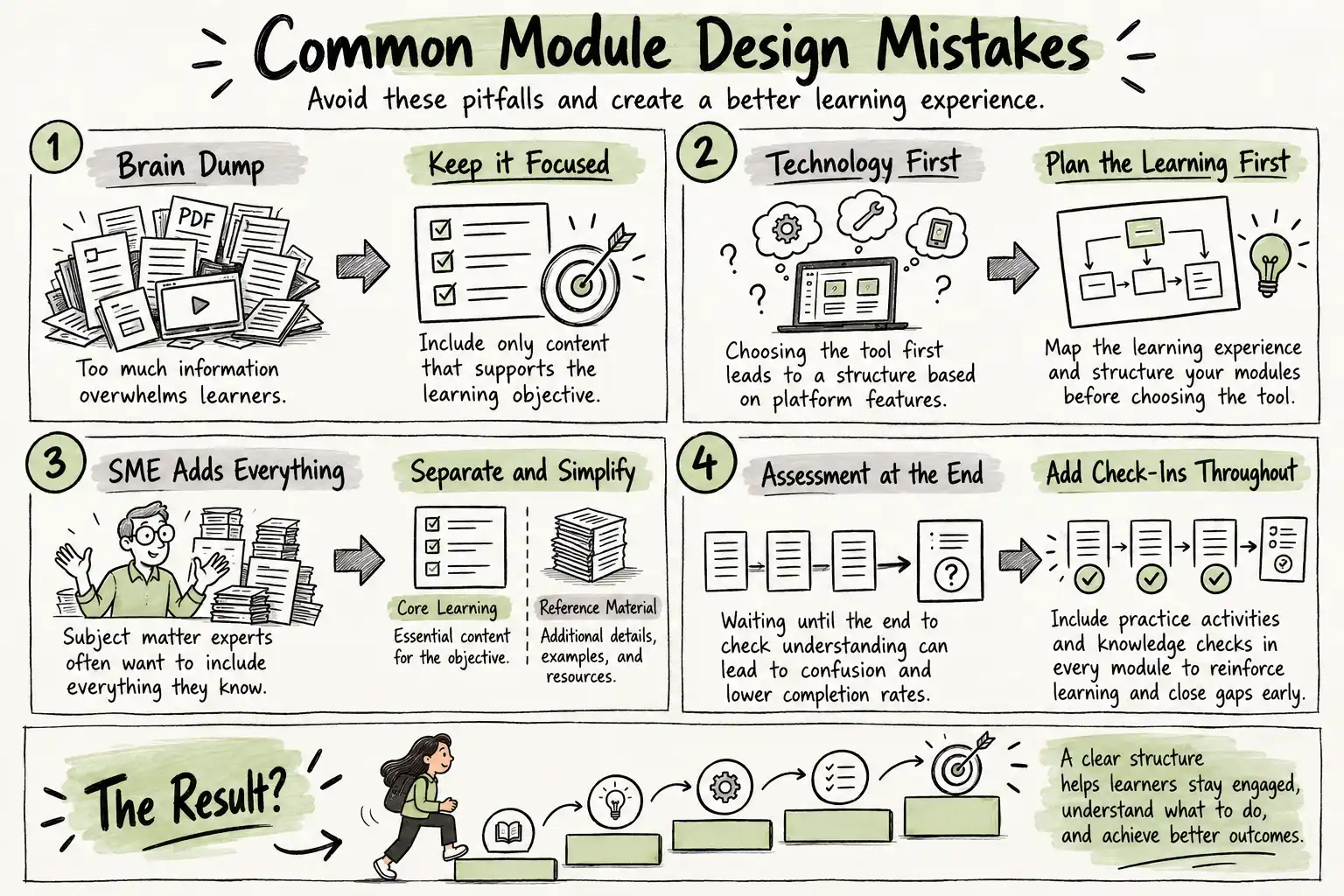
1. The Brain Dump
One of the easiest mistakes is including everything you know.
Subject matter experts naturally want to make sure their knowledge is represented accurately and completely. But a course is not intended to function as an encyclopedia.
Every piece of content should serve a purpose.
Ask: Does this information help the learner achieve the objective?
If not, consider removing it from the core learning experience or moving it into an optional reference resource.
2. Choosing Technology Too Early
The LMS or authoring tool should not determine your curriculum.
Start with the learner, objectives, content structure, and learning activities.
Then choose the technology that can support that design.
This keeps the focus on instructional effectiveness rather than platform features. Pasted markdown
3. Ignoring Subject Matter Expert Pushback
SMEs may sometimes feel that removing information reduces the quality of their course.
The solution is not to dismiss their expertise.
Instead, distinguish between essential learning content and supporting reference information.
If something is useful but not essential to achieving the objective, it can potentially become a downloadable resource, reference document, or optional reading.
This allows you to preserve valuable expertise without overwhelming the learner.
4. Burying Assessments
Waiting until the final exam to discover whether learners understood the material creates a weak feedback loop.
Provide opportunities to practice and check understanding throughout the course.
This allows learners to identify gaps before those gaps become larger problems. Pasted markdown
Summary
Structuring learning modules is more than dividing a long course into smaller pieces.
It is about creating a logical path that helps learners move from what they currently know to what they need to be able to do.
Start with clear learning objectives. Then organize content into manageable units, sequence those units from foundational concepts to more complex applications, and incorporate formative assessments throughout the experience.
A strong module structure also makes your course easier to develop, maintain, update, and deliver across different learning technologies.
Most importantly, avoid letting the volume of your existing content determine the structure of your course.
Your learners’ needs should determine the structure.
If your organization needs a trusted end-to-end partner to map, design, and deploy professional training programs, contact the Wizcabin team for a strategy consultation
Frequently Asked Questions
1. What is a training module?
A training module is a self-contained unit of instruction focused on a single learning objective. It typically includes instructional content, media, and an assessment to verify that the learner has mastered the specific concept.
2. How long should a single training module be?
An ideal training module should take between 5 and 15 minutes to complete. This microlearning format respects working memory limits and fits easily into busy professional schedules.
3. What order should I present my content in?
Always present content using scaffolded sequencing. Start with fundamental definitions and basic principles, then gradually introduce intermediate concepts, advanced applications, and complex problem-solving scenarios.
4. How do I prevent cognitive overload in online courses?
Prevent cognitive overload by breaking dense text into bite-sized paragraphs, utilizing whitespace, incorporating relevant visuals, and removing any extraneous information that does not directly support the module’s learning objective.
5. Where should I place formative vs. summative assessments?
Place formative assessments (quick quizzes, reflection checks) at the end of every individual module to reinforce learning. Place summative assessments at the very end of the course to evaluate overall mastery of the curriculum.
6. How do I handle subject matter experts who resist cutting dense content?
Frame the discussion around the learner’s working memory. Remind SMEs that if everything is emphasized, nothing stands out. Offer to move secondary reference materials into a downloadable resource library rather than keeping them inside the core instructional flow.
7. Should I choose my LMS or map my modules first?
Always map your modules first. Your instructional design, curriculum structure, and student engagement model should dictate your technology selection—never the other way around.
8. How does modular structuring impact technical standards like SCORM tracking?
Structuring content into clear, distinct modules makes it much easier to track completion and score data accurately when packaged as SCORM or xAPI files. Read our technical guide on How SCORM Works: Complete Technical Guide for more details.
9. Which authoring tools should I use to build structured modules?
Industry-standard cloud authoring tools like Articulate Rise and Storyline are ideal for building modular, responsive e-learning courses. Explore our Wizcabin Solutions & E-Learning Architecture to learn how we build custom courses using these tools.
10. How do I know if my learners are absorbing the material?
Combine completion metrics from your LMS with qualitative feedback and formative assessment scores. High completion rates combined with successful knowledge checks indicate that your module structure is working effectively.
Turn Your Content Into a Structured Learning Experience
Ready to turn your scattered training materials into a cohesive, high-impact curriculum? Contact the Wizcabin team for a strategy consultation to discuss your custom course development roadmap today.